
Checking Lake County Criminal History
Lake County records are split by event and custodian. The Clerk's ShowCase Web search is the strongest first stop for filed criminal cases. It shows the court case, docket events, charges, hearings, disposition, financial entries, and public document images when those images are available. The Lake County Sheriff's Office inmate search answers a narrower question about booking and current or recent custody. FDLE provides the statewide identity-based criminal history product. None of these sources replaces the others.
Gather a full legal name, other spellings, an approximate date of birth, and any known case or citation number. Similar names are common. A final match should rely on several identifiers and the record's own dates, court, and agency. Use this order:
- Search ShowCase Web by name or exact case number, then narrow by court type, filing date, judge, division, or status.
- Read the charge and final disposition separately. The first accusation is not always the offense that resolved the case.
- Compare the LCSO inmate search when booking, bond, arresting agency, or custody status matters.
- Use FDC Offender Search for state prison or community supervision and FDLE for a statewide Florida history.
- Ask the Clerk or sheriff for the source document when an online summary is incomplete, unclear, or lacks an image.
Lake County Records Have Four Custodians
Lake County's main justice offices sit within a few downtown Tavares blocks, yet each keeps a distinct record series. The modern Judicial Center houses court work and the Clerk's criminal counter. LCSO Central Records keeps incident and agency reports. The Detention Center maintains booking and inmate data. Older or administrative material may route through Records Storage. Physical closeness does not merge legal custody.
The Fifth Judicial Circuit's Lake County page shows the judicial center and local court programs.
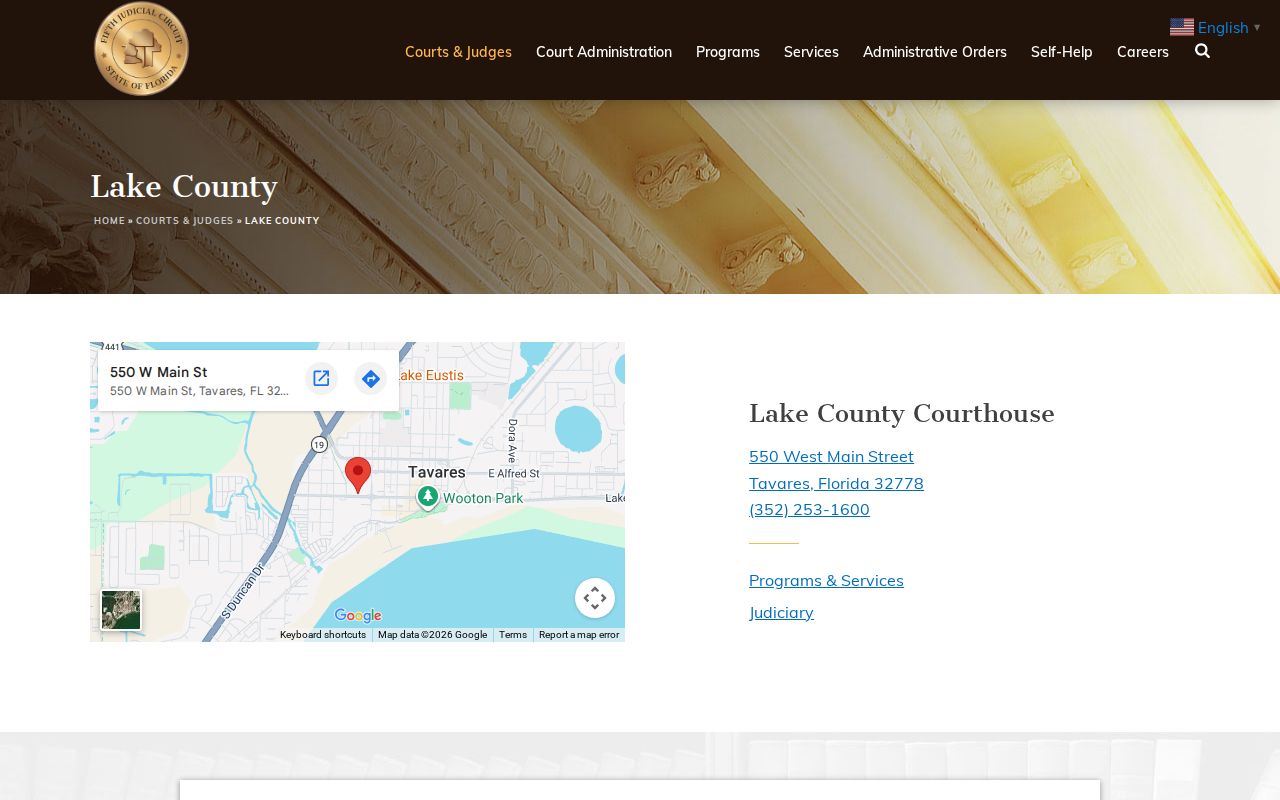
The official court view helps readers distinguish the current Judicial Center at 550 W. Main Street from the Historic Courthouse at 317 W. Main Street. Printed court records are handled through the Clerk, not at the sheriff's report counter.
Florida Official Background Checks
The Florida Department of Law Enforcement, Division of Criminal Justice Information Services, maintains the Florida Computerized Criminal History Central Repository. Any member of the public may use the Florida Criminal History Information Internet Search. An instant name and demographic search costs $24 plus a $1 card fee and gives an immediate, noncertified Florida result. A staff-handled search costs $24; FDLE states five business days for a noncertified result and six to seven business days for a certified result, plus mailing time.
Name searches depend on the data supplied and can associate the wrong person. For review of one's own Florida record, FDLE Personal Review uses fingerprints taken by a law-enforcement or criminal-justice agency and carries no FDLE fee. Lake County Sheriff's Office advertises fingerprint service at 360 W. Ruby Street; call 352-343-9885 to confirm the schedule and local charge.
The official FDLE interface shows the state product before payment.
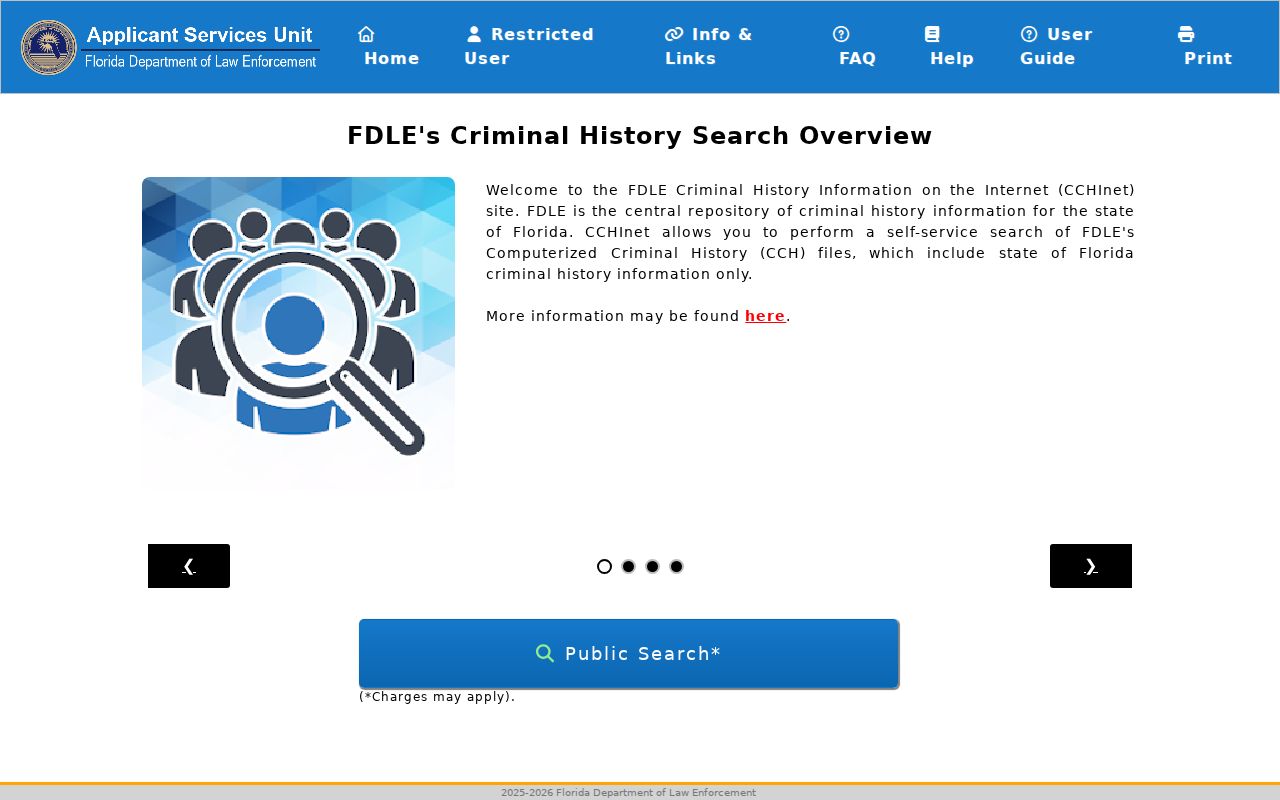
That service covers Florida public criminal-history information, not a certified copy of a Lake County court judgment or a national FBI identity history.
Lake County ShowCase Search Fields
ShowCase Web accepts several routes into the same Lake County docket. A known case number is the cleanest key. Name searching is useful when the number is missing, but the Clerk urges users to try plausible spelling variants. Filing dates, court type, case status, judge, and division help reduce a crowded result list. Public users may search without an account, while document access still depends on the case, role, content, and year.
| Field | Use | Format note |
|---|---|---|
| Last and first name | Find party records | Each name field allows up to 50 characters |
| Case number | Open an exact file | Use the local identifier when known |
| Citation number | Find citation matters | Required in a specialized citation search |
| Dates and status | Narrow results | Choose filing range and active or closed status |
| Court type | Separate case classes | Circuit felony and County misdemeanor are distinct |
The live ShowCase Web form displays the county's current controls.
A result list is an index, not proof that every document is available online. Cases before 2003 generally lack images, and criminal-traffic images do not predate 2009.
The Lake County Clerk records gateway is the official route to court services and record access.
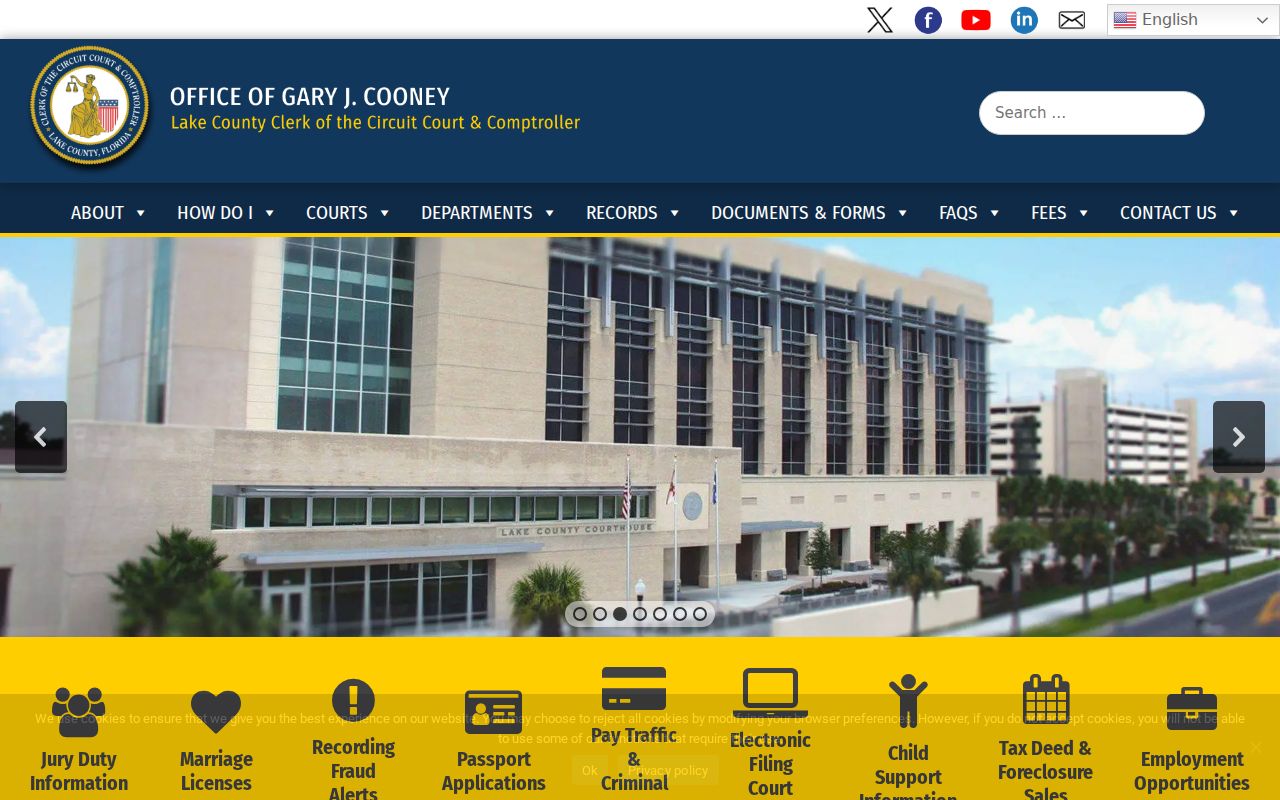
The gateway is also the safest starting point when a saved deep link changes during a Clerk website update.
Lake County Criminal Record Types
A criminal record can mean an agency report, booking sheet, court docket, repository history, corrections entry, warrant record, or registry profile. Lake County searchers should name the event they need before choosing the office. An incident report describes what an officer received or observed. Booking data records intake into custody. The court file follows the filed prosecution. FDLE compiles qualifying statewide identity-based history, while FDC tracks state custody and supervision.
- Incident and arrest reports: request them from LCSO Central Records or the city police agency that created them.
- Booking and inmate records: use the Lake County Detention Center and LCSO search channels.
- Criminal case files: use the Clerk for charges, docket entries, judgments, and sentences.
- State history: use FDLE for the Florida repository result and Personal Review process.
- Corrections and registry records: use FDC Offender Search and the FDLE offender registry for their limited purposes.
Lake County Central Records Archive
LCSO Central Records processes incident reports, calls for service, misdemeanor citations, traffic and boating citations, local record checks, and insurance requests. The unit scans incident reports into its Document Management System and retains them permanently. It also routes arrest-linked material by type. Felony and misdemeanor arrest reports go to the State Attorney. Notices to appear and misdemeanor citations go to the Clerk's misdemeanor department. Juvenile matters go to juvenile court offices, and work-in-lieu-of-arrest matters go to Teen Court.
Requests may be made through the official PDF, by phone at 352-343-9582 for a specific public record, or through Central Records at 360 W. Ruby Street and 352-343-9578. Describe the report number, date, place, record class, and requested format. Florida law does not require a purpose for an ordinary request. An email address supplied to LCSO becomes a public record.
The LCSO Central Records page explains the unit's work.
This routing explains why the sheriff's report and the Clerk's later case file should be requested separately.
Inside a Lake County Criminal Record
Read each field in context. A booking charge reflects the intake stage. The prosecutor may file a different count, reduce a charge, or decline it. The Clerk's disposition states how the filed count ended. FDLE may show qualifying arrest and disposition data from several Florida counties, but public output omits sealed, expunged, and most juvenile material. Dates and agency identifiers are vital when names are similar.
| Name & Identifiers | Legal name, aliases, date of birth, sex, race, agency number, or case number, depending on the source. |
|---|---|
| Arrest / Booking Data | Arresting agency, intake date, booking number, listed charges, bond, and custody details. |
| Charges & Statutes | The alleged or filed offense, count, level, and Florida statute citation. |
| Disposition | The result for each filed count, such as dismissal, acquittal, plea, or conviction. |
| Sentence | Jail or prison term, probation, fines, conditions, or other court-ordered terms. |
| Custody / Supervision | County jail, FDC prison, community supervision, release, or closed status where public. |
Lake County Booking and Custody
The LCSO inmate search is now name-only, a change the sheriff describes as a fraud-prevention measure. A profile can show booking identifiers, arrest date and time, arresting agency, physical descriptors, charge text, statute, bond information, court data, and release details. It does not answer whether a filed charge ended in conviction. Check the Clerk docket for that result.
Lake County Detention Center is at 551 W. Main Street in Tavares. Inmate Records is 352-742-4058, Booking is 352-742-4024, and the main jail line is 352-742-4000. State-sentenced custody shifts to FDC, so a missing county jail hit may call for a separate corrections search.
The official inmate form shows the current name-search rule.
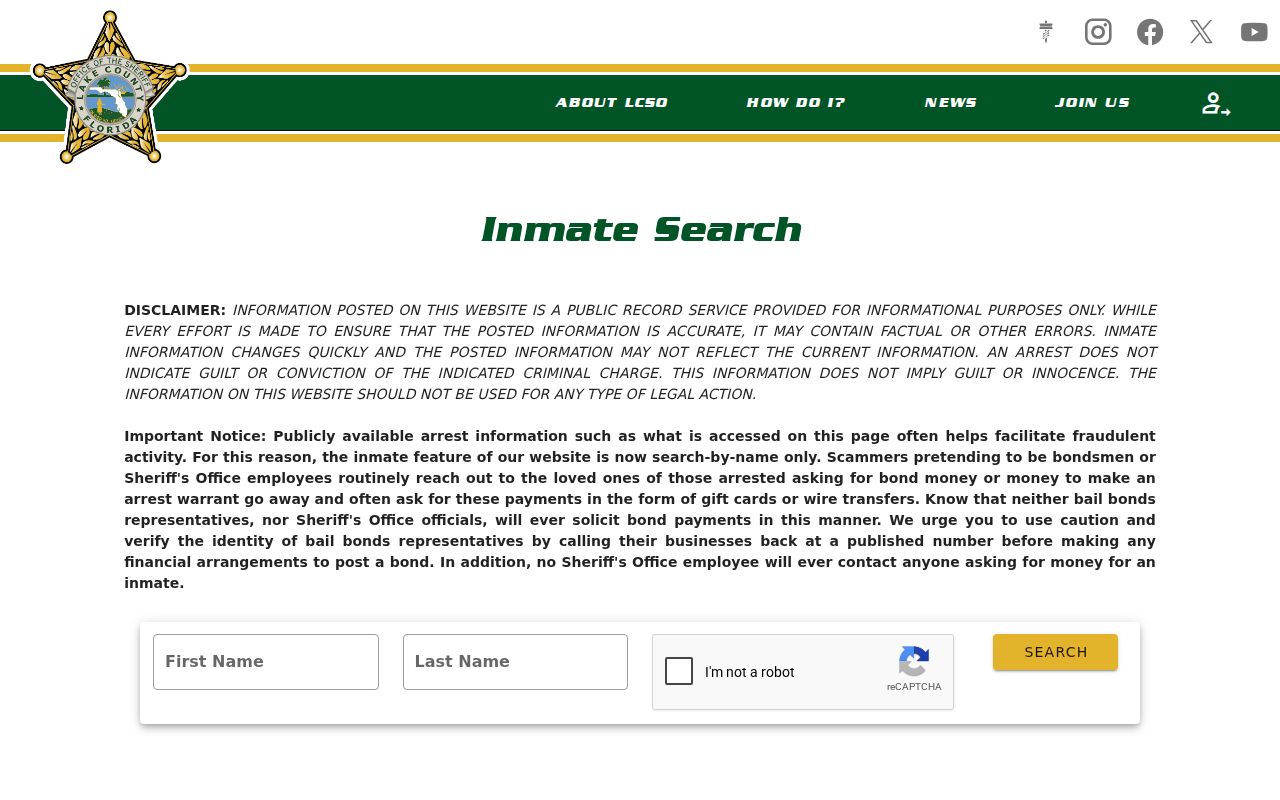
Use the interface without treating a booking as proof of guilt. The underlying court file remains the source for the case outcome.
Public Access Laws in Florida
Florida begins with broad public access, but the right is not unlimited. Chapter 119 governs agency records. Article I, section 24 of the Florida Constitution establishes a public right of access subject to exemptions. Court records follow Florida Rule of General Practice and Judicial Administration 2.420. Criminal-history dissemination, personal review, and record relief have separate statutes. Agencies must redact protected material rather than expose it merely because the rest of a report is public.
Key Statutes:
Chapter 119, Florida Statutes governs inspection, copies, exemptions, and agency response.
Section 943.053 controls dissemination of criminal-history information.
Section 943.056 gives a person a route to review and challenge their own Florida record.
Section 943.0585 governs court-ordered expunction.
Lake County Warrant Checks Are In Person
Lake County has an unusually important access rule: LCSO does not give warrant information by telephone. A person must obtain the information in person. Someone who cannot come to LCSO is directed to a local law-enforcement agency. The Warrants Division receives capiases, direct-case warrants, summonses, and other process, then enters qualifying records into local systems and FCIC or NCIC.
For one's own possible warrant, first inspect the Clerk docket for a capias or warrant event. Contact the issuing court about its case and use in-person law-enforcement verification. The Warrants Division number, 352-343-9788, is an administrative contact, not a phone verification line. A warrant can lead to arrest, and payment of an unrelated balance does not prove recall. Confirm that the issuing court signed a recall and that systems were updated.
The official LCSO warrant notice states the in-person rule.
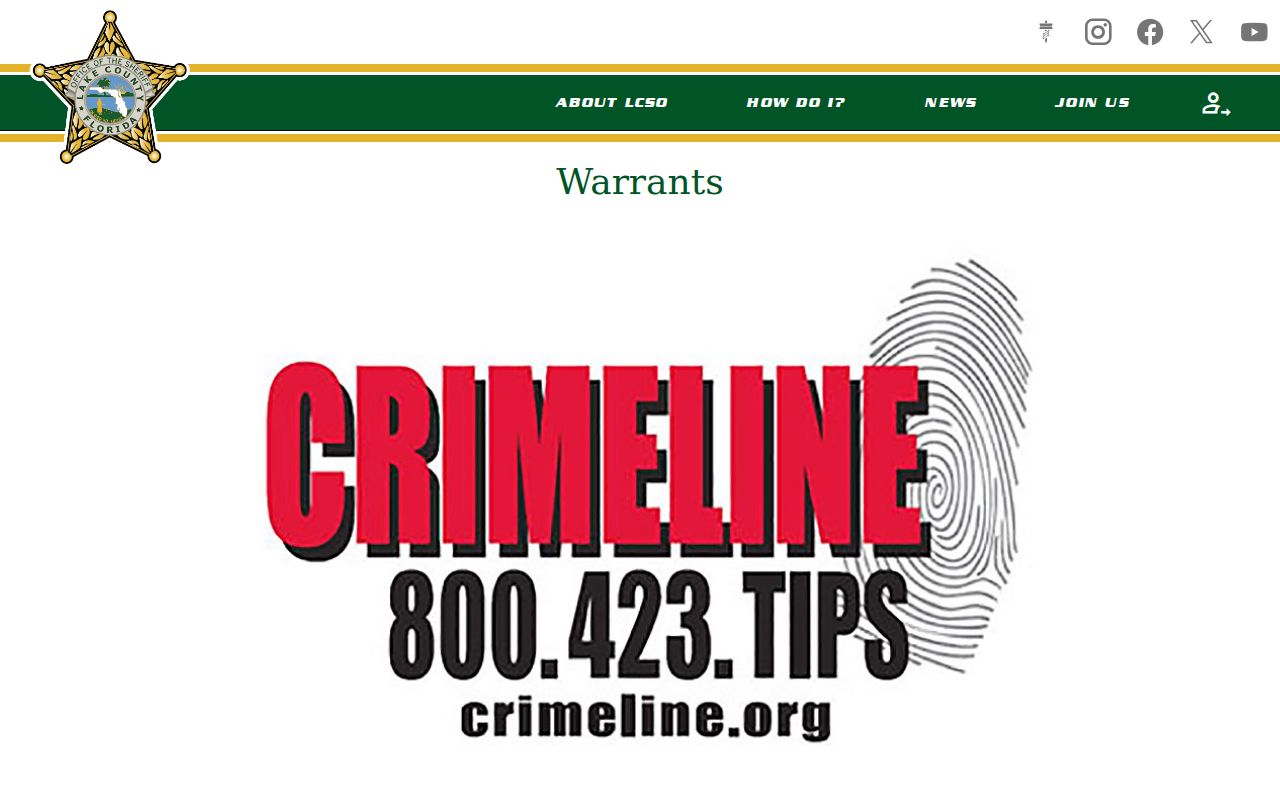
The pictured notice is the authoritative alternative to unofficial third-party warrant lists.
Sealed, Expunged, and Restricted Records
Lake County public searches do not expose every record. Juvenile material, victim information, active investigative content, medical data, intelligence information, and other protected fields can be withheld or redacted. A missing result can therefore mean restricted access, an identity mismatch, a reporting delay, an older unscanned file, or no record. It does not identify the reason by itself.
Florida uses both sealing and expunction. Eligibility starts with an FDLE Certificate of Eligibility and continues with a petition in the court that has jurisdiction. Sections 943.0585 and 943.059 govern the two remedies. The Lake County packet calls for a petition, sworn affidavit, certificate, service on the State Attorney and arresting agency, and a proposed order. Confirm the current packet and filing fee with the Clerk. A dismissal does not automatically erase an earlier agency booking record.
Lake County Records After State Transfer
County jail records stop being the main custody source when a person enters the Florida prison system or state community supervision. FDC Offender Search can display current and historical custody or supervision indicators. The Lake County docket remains useful for the sentencing order, probation terms, violation filings, modifications, revocation, and termination. Those products describe related events but are not interchangeable.
The FDC search gateway separates county custody from state records.
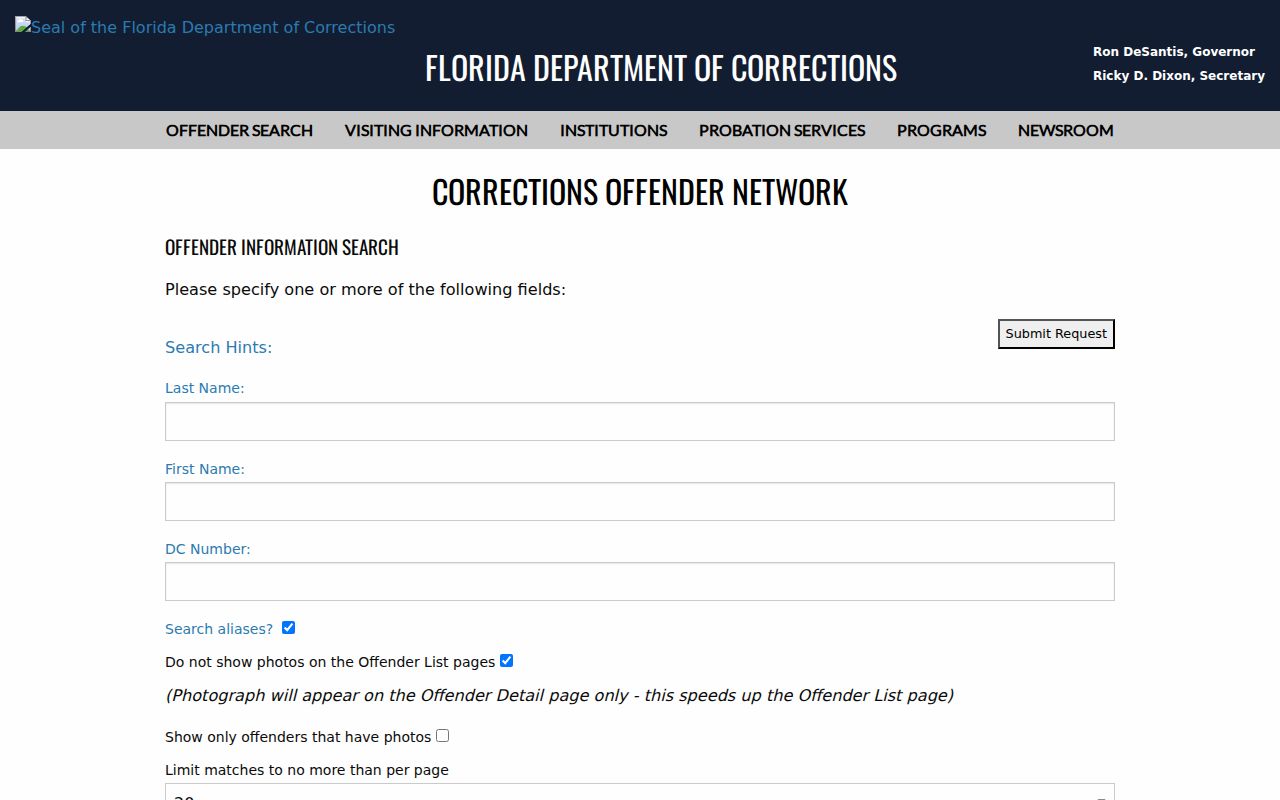
For release decisions and older parole questions, the Florida Commission on Offender Review is the separate authority. Florida abolished parole eligibility for most newer offenses, so offense and date matter.
Lake County Offender Registry Layer
The Florida Sexual Offenders and Predators Search is a purpose-specific public safety registry managed by FDLE. It is not a general criminal-history report. Searches can use a name or a geographic area, and profiles contain identity, designation, address, vehicle, offense, and status fields allowed by Florida law. The dedicated Lake County sex offender search explains search fields, registration duties, local verification, and lawful use in more depth.
The official FDLE registry search supplies the statewide interface.
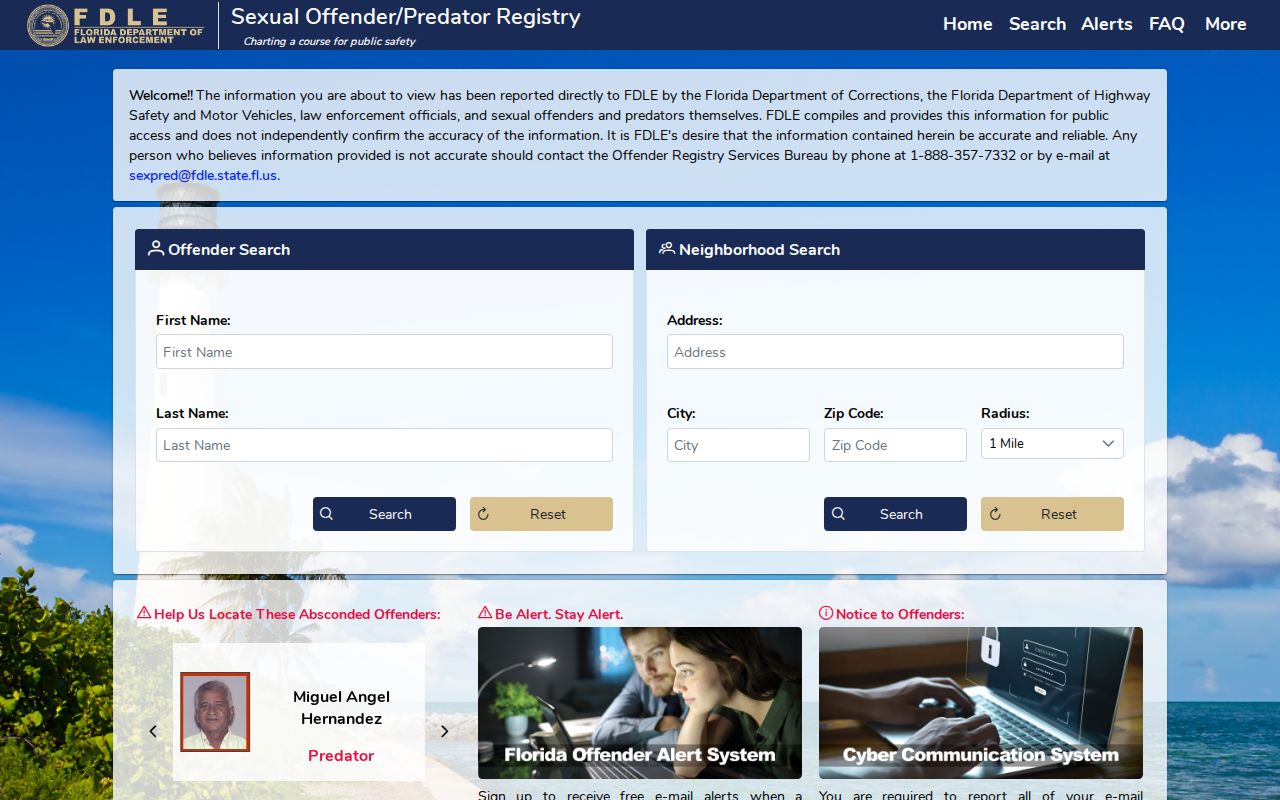
Registry information supports personal and community safety. It may not be used to harass, threaten, or take unlawful action against a registrant.
Lake County Criminal Records by City
City police departments retain the reports they create, even though bookings converge in the Lake County detention system and court cases go through Circuit or County Court. Florida has no present-day municipal courts. Clermont, Leesburg, and Groveland each offer distinct report-request routes, while the Clerk provides the countywide docket. The city pages keep those local channels at the center.
Clermont Criminal Records
52,812 · JUSTFOIA requests, daily incident reports, and county court routing.
Leesburg Criminal Records
38,905 · Police Records contacts and direct incident-report request channels.
Groveland Criminal Records
25,526 · City public-record form and police records phone routing.