
Checking Criminal History in Leesburg
Begin with the custodian, not a broad name search. Leesburg Police keeps its own reports, and Leesburg operates its own public safety answering point. The Lake County Sheriff holds custody records after booking. The Lake County Clerk records the charges and court result. FDLE adds statewide Florida criminal-history information, subject to legal limits.
Use this sequence for a Leesburg criminal-record check:
- Identify whether the desired item is a police report, dispatch record, booking sheet, citation, or court case.
- Give Leesburg Police Records the incident number, record type, date, location, and a narrow request description.
- Ask the city for CAD or 911 material tied to a Leesburg-dispatched event.
- Use LCSO for jail, inmate, or booking information and the Clerk for filed charges and outcomes.
- Use the FDLE public name search only when the goal is broader Florida history.
A missing result at one step does not end the search. It may mean the record is held elsewhere or has not reached the next system.
Seven Leesburg Police Record Types
Official Leesburg Police annual reports describe a dedicated Records Section. Its work includes quality control, public requests, and routing documents to the State Attorney, Public Defender, and Traffic Clerk. The unit's records are more varied than a single “criminal record” label suggests.
- Crime report
- A police account of a reported offense and the initial response.
- Information report
- An event record that may document facts without alleging a crime.
- Crash report
- A traffic collision record, subject to its own access rules.
- Citation or warning
- An officer-issued traffic or ordinance document.
- Field-contact card
- A record of an officer contact that is not itself a conviction.
- Arrest report
- The city officer's report supporting an arrest, distinct from the county booking sheet.
The 2019 and 2018 reports also describe investigative supplements and other duty-generated files. State the exact category when making a Leesburg request.
Leesburg Police Department Records
The Leesburg Police Records Section processes incident material, enters citations and warnings, answers public-record requests, and sends records through the justice system. Research also identified an official address at 115 E. Magnolia St., Leesburg, FL 34748, phone 352-728-9860, and fax 352-365-1026. Because live city pages can change, confirm the current counter details before travel.
The official incident-report request page is the proper city starting point for report copies. No verified current fee, response deadline, or dedicated form was available in the research. Do not assume that silence means there is no access. Describe the desired file and ask Records about the current submission and delivery choices.
The city's incident-report page shows the official route for Leesburg police-record requests.
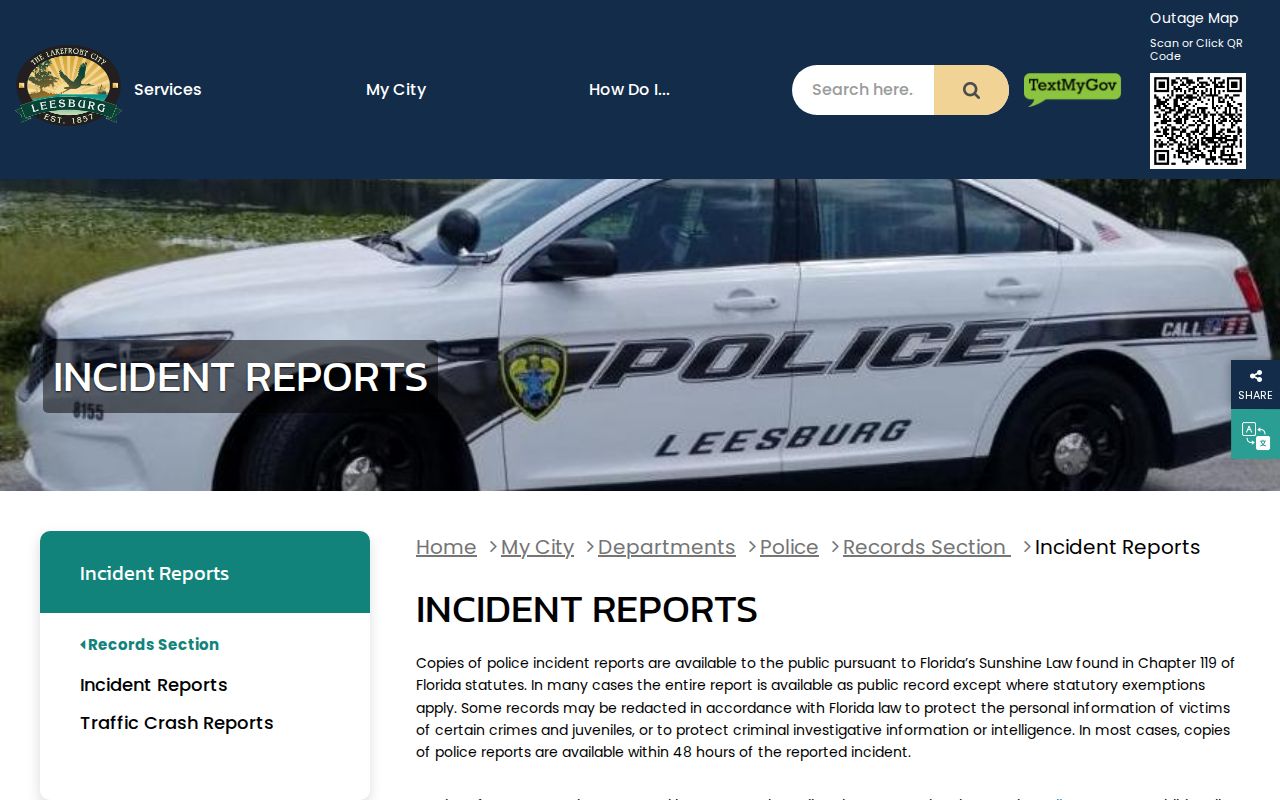
That city channel should be used before a county search when Leesburg Police created the report.
Requesting Leesburg Records by Date
An incident number is the best key, but it is not always available. A requester who knows only a date and street should give the tightest time range possible, the location, the type of event, and whether the request seeks a report, supplement, audio, or another attachment. Names may help, but a place and time can distinguish people with similar names.
| Request detail | Use |
|---|---|
| Record type | Separates crime, arrest, crash, citation, warning, field contact, and dispatch material. |
| Incident number | Provides the strongest direct match when known. |
| Date, time, and location | Narrows the city records search. |
| Requested components | States whether supplements, audio, or attachments are sought. |
| Delivery contact | Allows questions about scope and available release. |
Ask for a public, redacted version if victim-protected or investigative details prevent release of the full file. Avoid adding private data that the office does not need.
Leesburg Arrests and Bookings
A Leesburg arrest report and a Lake County booking sheet serve different purposes. The city report records the officer's action and facts reported at the scene. After intake, LCSO creates a custody record. City arrestees enter the county detention system in Tavares; no official source identifies a separate Leesburg city jail roster.
| Record | Custodian | Main content |
|---|---|---|
| Arrest report | Leesburg Police | Officer narrative, alleged conduct, arrest basis, and city report data. |
| Booking sheet | Lake County Sheriff | Intake, custody identifier, booking data, and release or bond fields when public. |
| Criminal case | Lake County Clerk | Filed charges, hearings, pleas, disposition, and sentence. |
For county custody information, call 352-742-4000; Inmate Records is 352-742-4058 and Booking is 352-742-4024. An arrest is not proof of guilt, and the court outcome may differ from the arresting allegation.
Leesburg Dispatch, Tavares Jail Records
Leesburg operates its own public safety answering point. LCSO's Communications Center lists Leesburg Police as a separate PSAP rather than an agency it dispatches. That makes Leesburg the logical custodian for city CAD, 911 audio, and dispatch material associated with a Leesburg event.
Custody still converges at the county system in Tavares. This is where local geography can trip up a request: city communications made the call record, city police made the incident or arrest report, and LCSO made the booking file. Ask each office only for the stage it controls.
A CAD record is a computer-aided dispatch log. It can show call handling and unit activity, but it is not the officer's full incident narrative. Likewise, 911 audio captures a call rather than the later charging result. State exactly which item is needed. If a court case followed, use the Clerk for the judicial record instead of asking dispatch staff to reconstruct the outcome.
Note: Dispatch ownership and jail custody follow different agency lines in Leesburg, even when both records concern the same event.
Municipal Court Records in Leesburg
Leesburg has no municipal court. Florida abolished municipal courts in the 1973 Article V reorganization. City ordinance, misdemeanor, and criminal traffic cases are handled in Lake County Court, while felony cases belong to the Fifth Judicial Circuit. Search the Lake County Clerk Case Maintenance System for the court stage of a Leesburg matter.
| Court Name | Lake County Court and the Fifth Judicial Circuit, not a Leesburg municipal court. |
|---|---|
| Case Types Heard | City ordinance, misdemeanor, criminal traffic, and felony cases. |
| Case Lookup Channel | Countywide Clerk portal, Clerk counter, phone, or court-record request. |
| What the Docket Shows | Case number, parties, charges, events, disposition, and sentence when public. |
| Copies and Fees | Use the current Lake County Clerk schedule; no separate Leesburg court-copy fee was verified. |
The portal may accept name, case number, citation number, and available date or case-type filters. Maintenance can occur from 9 p.m. to midnight. An absent online image is a reason to ask the Clerk, not proof that no record exists.
Leesburg Clerk Drop Box Limits
The Clerk maintains a drop box at 1720 N. Citrus Blvd., with a published weekday pickup at 10:30 a.m. It is useful for filing or payment delivery. It should not be described as a full city court office or as proof that staff at that address can answer every criminal-record question.
Use the county portal for a first search. For a missing image, older file, or unclear ordinance case, contact the Lake County Clerk's criminal court operation. The city may appear in agency, citation, docket, or ordinance information even though the search is countywide.
Where Leesburg Records Go
Leesburg Records sends appropriate material to the State Attorney, Public Defender, and Traffic Clerk. Once charges are filed, the Lake County Clerk preserves the court docket and case documents. Arrest and fingerprint data may also reach FDLE, where the statewide repository builds an identity-based Florida history.
Record flow: Leesburg Police Department › Lake County Courts › Florida Department of Law Enforcement
The flow is not instantaneous. A city report can exist before a booking entry or case. A court disposition may post after the arrest source, and a sealed or expunged matter is treated differently from an ordinary public record. For a full county-level explanation of the court stage, consult Lake County criminal court cases.
Leesburg Records Workload in Context
The 2018 Police annual report gives historical, not current, scale. It recorded 5,323 incident reports, 2,647 criminal arrest reports, 3,734 investigative supplements, 3,495 traffic citations, about 100 public-record requests per week, and 4,478 counter visitors. It also listed 2,187 local record checks and 127 fingerprint services.
Those figures show why a precise request matters. They must not be treated as a present crime rate. One incident can generate a base report and several supplements, and a public-record request is not an offense. The source year should remain attached whenever these figures are used.
The FY2023–24 city budget uses another kind of measure. It lists 72,800 police CAD calls in 2021–22 and 75,712 in 2022–23, then gives 77,983 as a 2023–24 target. Targets are plans, not completed outcomes. It also labels a reduced crime-rate measure as a record low. Keep the fiscal year, measure name, and actual-versus-target distinction attached so the figures are not mistaken for arrest or conviction totals.
Leesburg Growth and Record Demand
Census QuickFacts estimates 38,905 Leesburg residents in 2025, up from 27,000 in the 2020 Census. The V2025 series reports a 43.9 percent change from its estimates base. Growth is useful service-demand context, but it does not prove a rise in crime.
The Census interface provides the official Leesburg population and geography source.
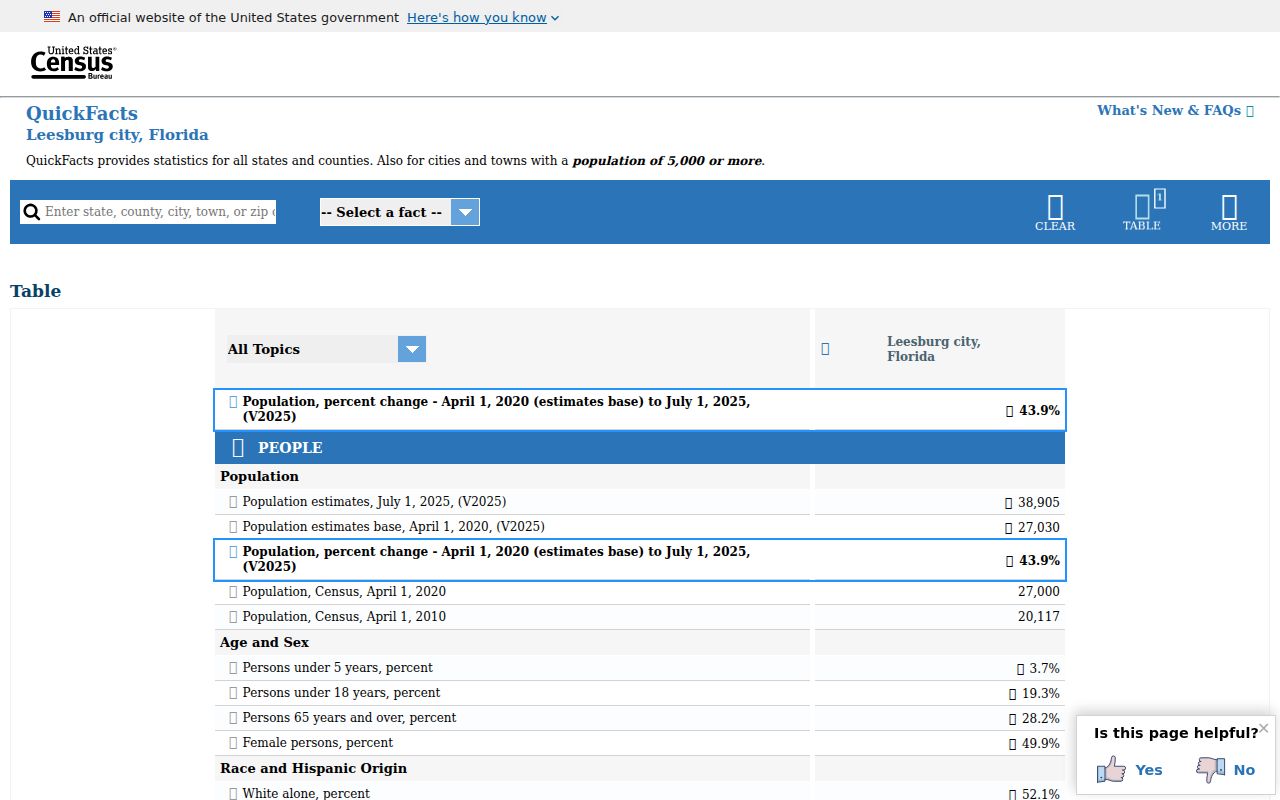
Its 38.45 square miles also show why date, street, and responding agency can be more useful than a city name alone.
LakeFront TV Is Not Records Search
LakeFront TV is Leesburg's city-government information channel. It carries public meetings and civic updates, not a police blotter or criminal-history database. A broadcast can supply context about city policy, but the Police Records Section remains the custodian for police files.
The official LakeFront interface identifies it as a government programming channel.
Use the channel to follow city business, then request the underlying public record from the office that created it.
Leesburg's lake-centered civic identity can make video and meeting archives useful for policy history. Venetian Gardens and the city's position between Lakes Harris and Griffin are local context, not record-search filters. For a police event, a street and date still provide the better search key. For a rule or budget discussion, the government channel may point to the meeting where the issue was addressed.
Public Access Rules in Leesburg
Florida's access laws apply to Leesburg records, yet exemptions still protect parts of police and court files. Active investigative details, juvenile information, Social Security numbers, and protected victim data may be withheld or redacted. A requester can ask whether the public portions are separable when the complete record cannot be released.
Key statutes:
Florida Public Records Law, Chapter 119 provides access to nonexempt records held by state and local agencies.
Florida Statutes section 119.071 protects specified law-enforcement, victim, and personal information.
Florida Statutes section 943.053 controls public dissemination of criminal-history information.
A police report, booking sheet, and court docket can have different public fields. Confirm any key fact with the office that maintains the original record.