
Checking Criminal History in Clermont
Use the record's origin as the first filter. The Clermont Police Professional Standards and Records Division handles reports created by city officers. Lake County agencies hold the later booking and court stages. An FDLE search is broader, but it does not replace the source files and omits material that is sealed, expunged, or restricted.
A careful Clermont criminal-record search follows this order:
- Ask Clermont Police for the incident, crash, citation, or arrest report when city officers handled the event.
- Use JustFOIA for a copy of an existing police report, with a tight date range, location, and report number if known.
- Check Lake County Sheriff's custody channels for a booking or inmate record.
- Search the Lake County Clerk portal for filed charges, hearings, disposition, and sentence.
- Use FDLE's Florida Criminal History Information Internet Search when a statewide Florida name search is needed.
These sources can disagree without one being false. Each captures a different stage, and updates may reach them at different times.
Clermont Police Reports Start in JustFOIA
Clermont nominates JustFOIA as its police-report copy channel. It is a request and delivery system, not an instant name search. A useful request identifies the type of file, incident or case number, date, location, and a narrow range. Contact details can help staff clarify the scope and send a cost estimate or response. Live controls may change, so the description field matters more than assumptions about a fixed form.
The official JustFOIA request screen shows where Clermont police records requests begin.
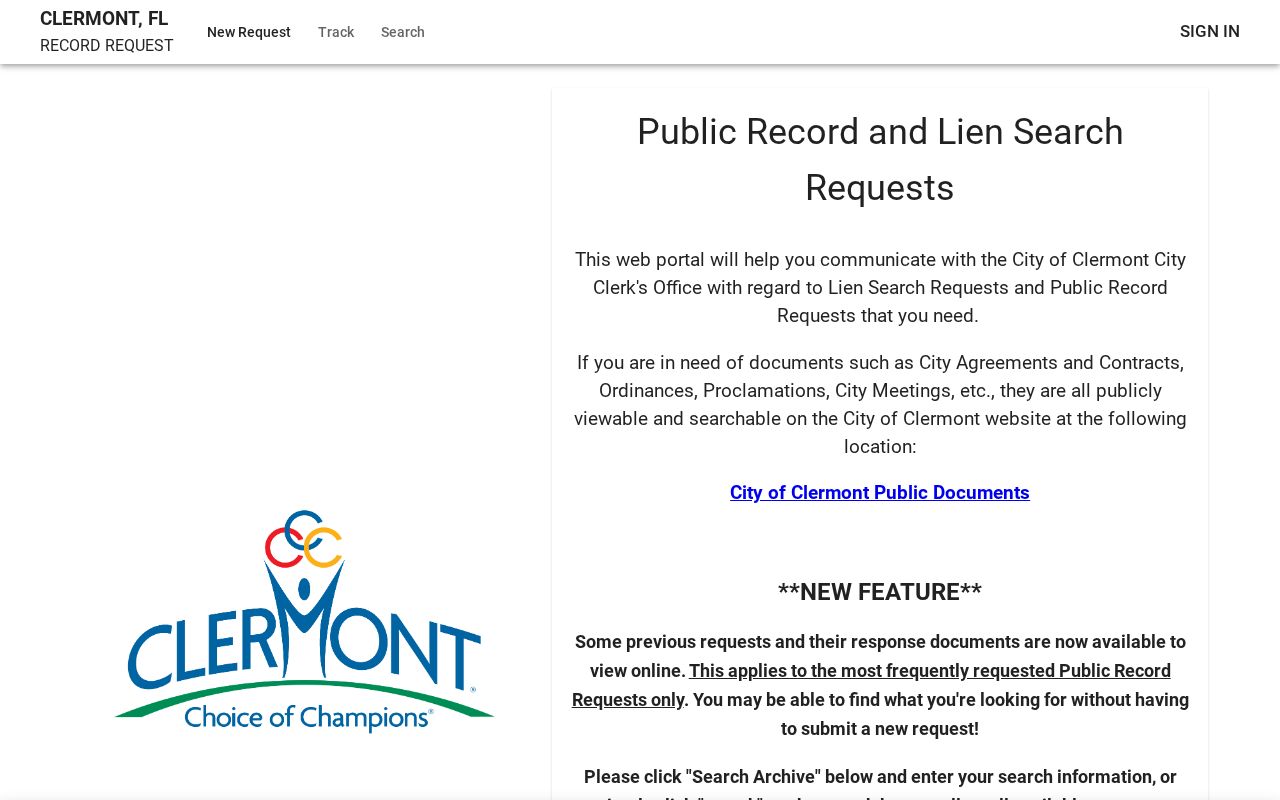
The portal separates a request for an existing record from a search of court or statewide criminal history.
| Request detail | Why it helps |
|---|---|
| Record type | Directs the request to police or public safety. |
| Incident number | Distinguishes the exact event. |
| Date and place | Narrows a search when no number is known. |
| Requested parts | Clarifies whether the request includes a report or attachments. |
| Delivery contact | Lets staff discuss scope, cost, or release. |
Clermont Police Department Records
The Professional Standards and Records Division is at 3600 S. Highway 27, Clermont, FL 34711, and its published phone is 352-536-8442. It retains, protects, distributes, and disposes of Clermont police records. The unit also answers public-record requests and compiles statistics for FBI reporting. City Hall at 685 W. Montrose St. and 352-394-4081 is a fallback, but police files should go to the named division or JustFOIA first.
The 2022 Clermont Police annual report says Records stores and distributes police reports, crash reports, citations, and other documents made in police work. It also handles fingerprint requests and Coplogic submissions. That scope explains why a single police event can produce several files rather than one all-purpose criminal record.
The city's official Professional Standards page profiles the Clermont records custodian.
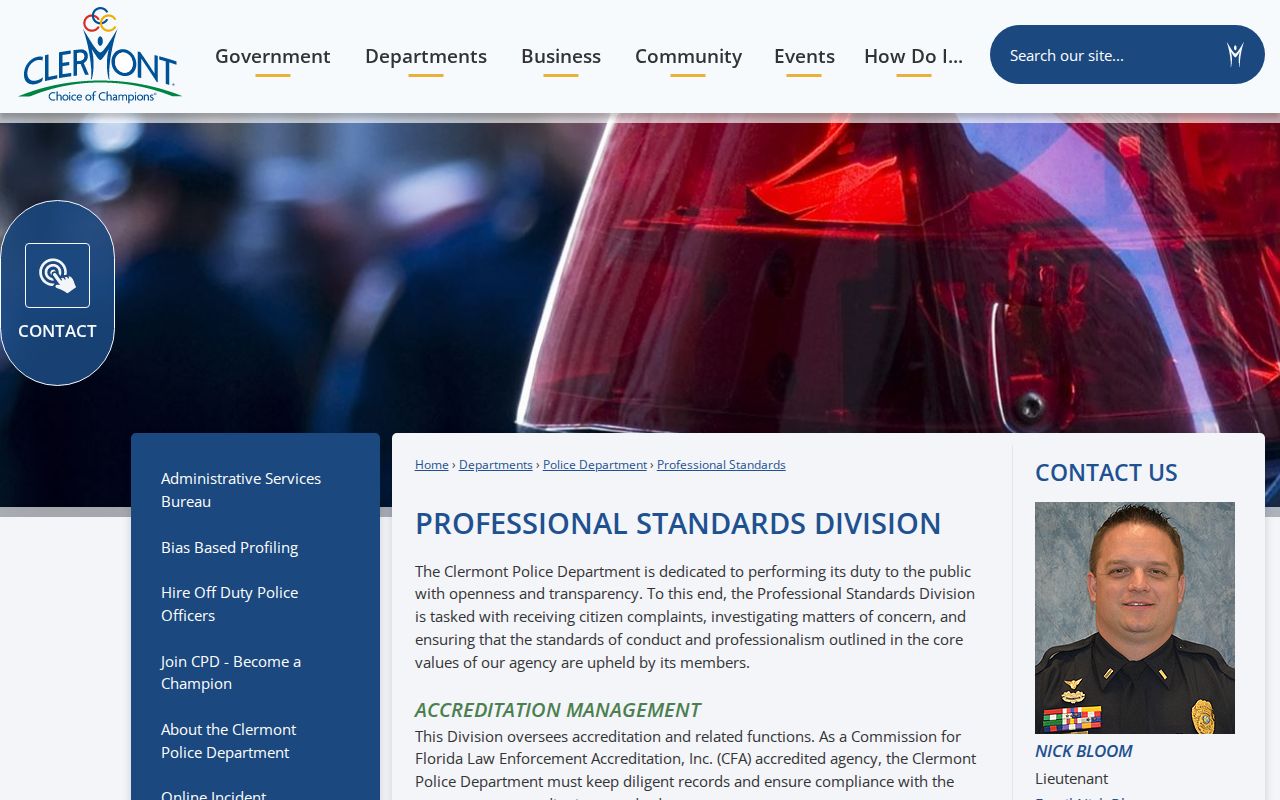
Its duties make this division the right first stop for a report made by a Clermont officer.
Coplogic Creates Clermont Reports
Coplogic serves a different task. The Clermont Police Resources and Links page sends eligible nonemergency events to an online incident-reporting system. It creates a new report for review. It does not retrieve an old report and does not show a person's criminal history. Emergencies belong with 911.
The live process checks whether the event is in Clermont's jurisdiction, is not an emergency, and fits an available incident type. A user then supplies location, date, narrative, and contact details. Events outside city limits route to the proper agency, and a known suspect or immediate evidence need may require an officer rather than online filing.
The official resources page places reporting tools beside victims' rights and other police materials.
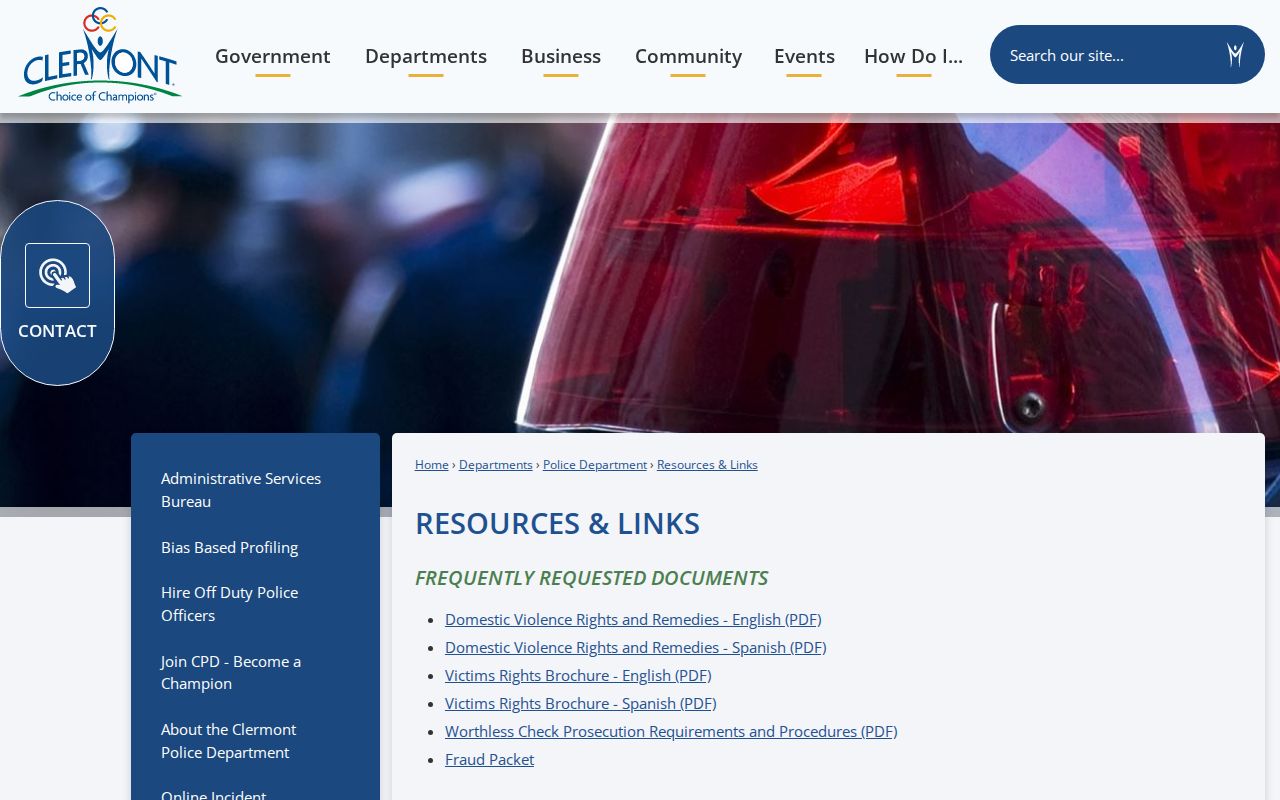
That layout reinforces the difference between creating a report, requesting a copy, and searching a case.
Clermont Arrests and Bookings
Clermont does not publish a separate city-jail roster. An arrest report made by Clermont Police remains a city record, but custody information belongs to the Lake County Sheriff's detention system. Jail and inmate information is available at 352-742-4000, Inmate Records at 352-742-4058, and Booking at 352-742-4024. The main Lake County Detention Center is at 551 W. Main St. in Tavares.
This split is vital. A police report can describe why an officer acted, while a booking sheet documents intake and custody. Neither proves guilt. Filed charges and the outcome appear in the clerk's court record. Readers looking beyond the initial arrest can use the dedicated Lake County arrest lookup for county-level access channels.
Note: A Clermont police arrest report and a Lake County booking record document related events, but they are not the same file.
Clermont South Lake Intake Records
Clermont is the only one of Lake County's three largest cities that contains the South Lake District Intake Facility. A current Sheriff's procurement document places it at 15855 State Road 50. The facility averages four to six intakes per day, keeps no one longer than 12 hours, and can handle larger planned-operation intakes.
That short stay does not create a separate Clermont jail system. A person processed there enters Lake County detention records and may move to the main jail in Tavares. For search purposes, start with city police for the arrest report and use LCSO for booking or inmate status. The geography changes where intake may occur, not who keeps the county custody record.
Timing matters when a family member is trying to locate someone. A very recent Clermont arrest may still be moving through intake, so city police can confirm the originating report while LCSO answers custody questions. If no public booking entry is visible, call the official jail or booking lines rather than treating a brief South Lake stay as a separate local roster. Once prosecutors file charges, the Clerk becomes the source for the case number and court schedule.
Municipal Court Records in Clermont
There is no present-day Clermont municipal court. Florida's 1973 Article V reorganization ended municipal courts and placed trial work in county and circuit courts. Lake County Court handles city ordinance matters, misdemeanors, and criminal traffic. Felonies proceed in the Fifth Judicial Circuit. The required city-court search is therefore the Lake County Clerk court-record portal, not a city-branded docket.
| Court Name | Lake County Court for ordinance, misdemeanor, and criminal traffic matters; Fifth Judicial Circuit for felonies. |
|---|---|
| Case Types Heard | Clermont ordinance citations, misdemeanors, criminal traffic, and felony proceedings. |
| Case Lookup Channel | Lake County Clerk Case Maintenance System, clerk counter, phone, or records request. |
| What the Docket Shows | Case number, parties, filed charges, docket events, disposition, and sentence when public. |
| Copies and Fees | Use the current Clerk fee schedule; city sources do not state a separate Clermont court-record fee. |
A clerk drop box at 290 Citrus Tower Blvd., Suite 116, has a published weekday pickup at 10:45 a.m. It is a filing and payment delivery point, not a promise that on-site staff can answer every records question.
Clermont Incident Reports Need Context
The city's Daily Incident Reports page publishes recent incident numbers, categories, locations, and dates. It works like a limited official blotter. An incident entry does not establish that an arrest occurred, that a prosecutor filed a charge, or that a court found anyone guilty.
The official incident page gives a quick view of recent Clermont police activity.
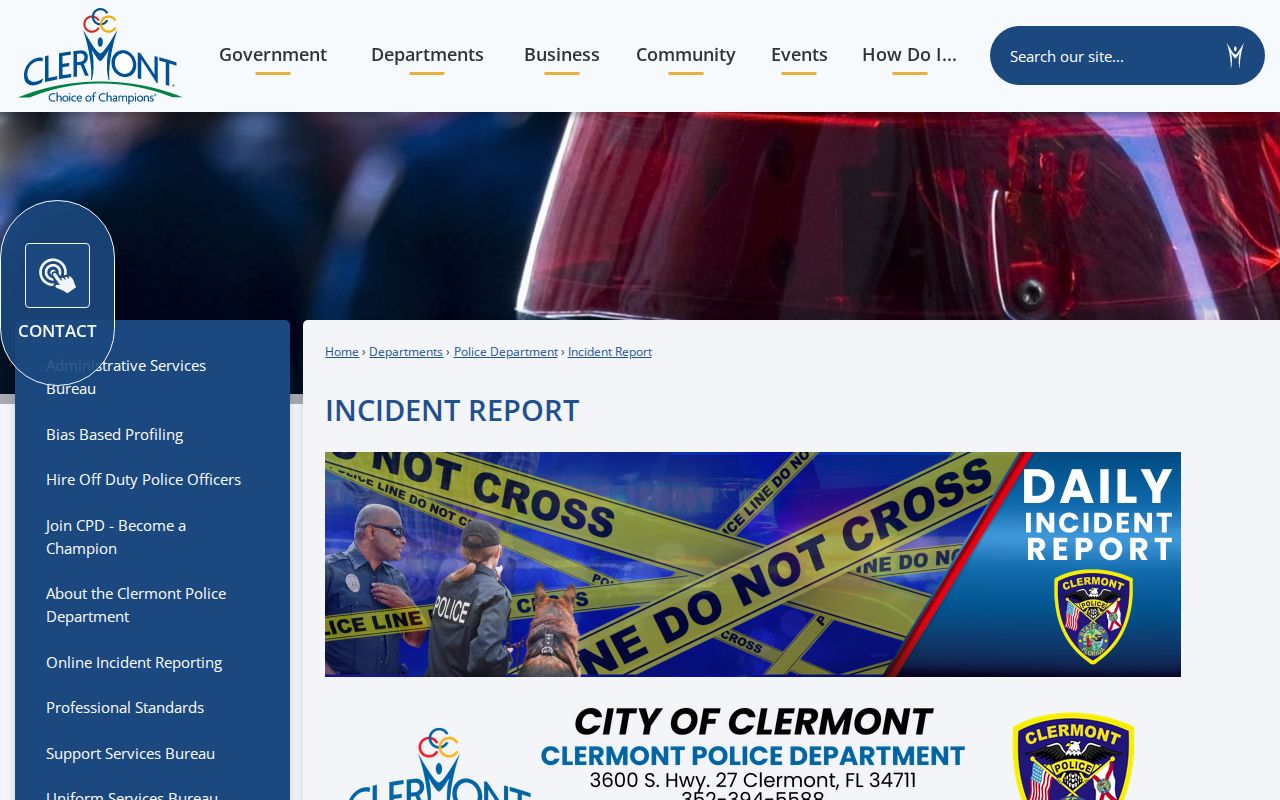
Use its incident number as a key for a focused JustFOIA request, then consult county sources only if the matter reached booking or court.
Where Clermont Records Go
A Clermont record can move through several custodians. Police retain the incident and arrest documents. The State Attorney receives arrest-linked material for a charging decision. The Lake County Clerk maintains the judicial case, while arrest and fingerprint information may reach FDLE's central repository. A dismissal in court does not by itself erase the earlier police or booking file.
Record flow: Clermont Police Department › Lake County Courts › Florida Department of Law Enforcement
For fresh activity, city police or LCSO may have the first record. For pleas, motions, judgments, and sentences, use the clerk. FDLE is the broader Florida history channel, but reporting lag, identity matching, and legal restrictions can make its result differ from the local source.
Clermont Growth Changes Record Demand
Census QuickFacts estimates Clermont at 52,812 residents in 2025, compared with 43,021 in the 2020 Census. That is nearly 9,800 more residents in five years. It is useful context for request volume and city service demand, but it does not show that growth caused crime.
Clermont grew from citrus-and-lakes roots into the “Choice of Champions,” with a strong athletic-training identity. Those changes help explain why current agency boundaries and modern request tools matter. They do not change the legal distinction among police, booking, court, and statewide records.
Crime statistics also need a source label. Clermont Police documented a shift from the older Uniform Crime Reporting system toward FIBRS and NIBRS. NIBRS means the National Incident-Based Reporting System, which collects more incident detail than the older summary model. Counts from different systems should not be placed side by side as if the methods stayed fixed. For a personal record question, the underlying report and court docket are more useful than a broad city statistic.
Fixing a Clermont Record Request
If a request returns no match, check jurisdiction before assuming the record does not exist. LCSO dispatches Clermont Police, but that does not make each city police report an LCSO file. An event outside city limits may belong to the Sheriff's Office or another agency. Confirm the street, date, responding unit, and report number.
Then test the record type. JustFOIA is for a copy from Clermont Police. Coplogic creates a report. The daily incident page gives incident-level clues. LCSO holds county custody data, and the clerk holds the case. These distinctions prevent the most common wrong-office search.
When the file concerns a victim, ask what can be released without protected details. Clermont's resources page provides victims' rights materials in English and Spanish, along with domestic-violence rights and remedies. Those resources explain rights and support; they are not substitutes for the record request. A narrowly framed request for the public portion can help Records separate releasable facts from exempt content.
Public Access Rules in Clermont
Clermont police records and Lake County court files are subject to Florida access law, but public access is not the same as unrestricted release. Agencies may redact protected victim data, active investigative details, juvenile material, Social Security numbers, and other exempt information. Court images may also be restricted under judicial access rules even when a docket entry is visible.
Key statutes:
Florida Public Records Law, Chapter 119 establishes access to nonexempt state and local government records.
Florida Statutes section 119.071 identifies exemptions for sensitive law-enforcement and victim information.
Florida Statutes section 943.053 governs dissemination of criminal-history information.
Ask for a redacted public copy when a full file cannot be released. A narrow request often makes review easier and helps the custodian identify separable public material.